How did this fuel truck get so far off the road? Jack didn’t ask, he just pulled him back onto it.
(Logo was removed from side of tank.) Click to enlarge.
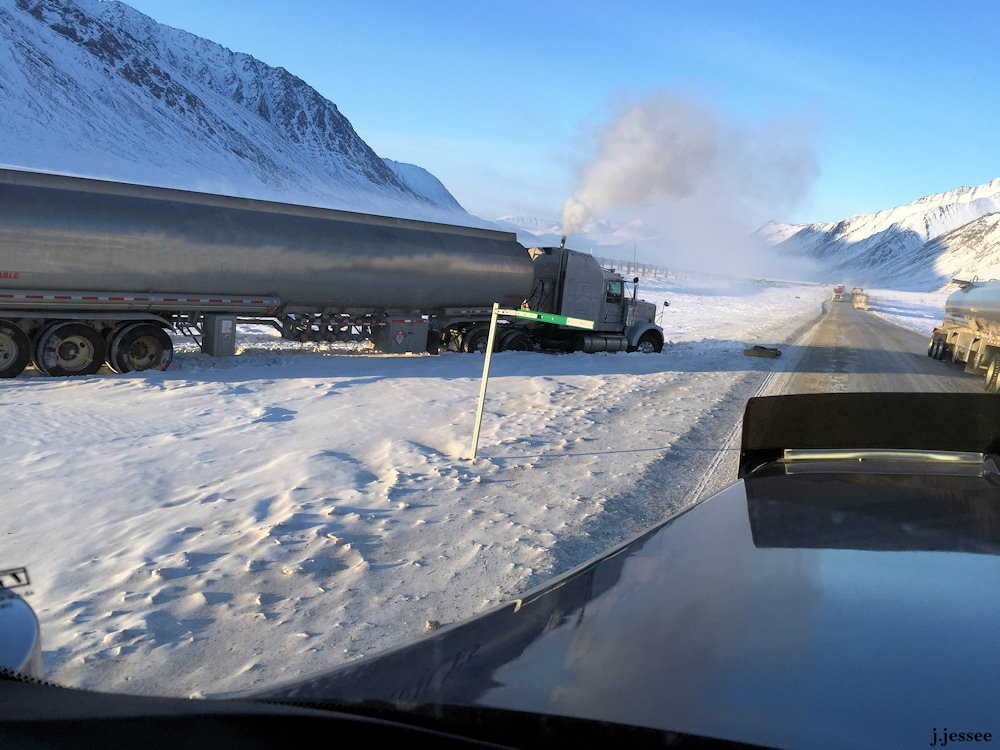
How did this fuel truck get so far off the road? Jack didn’t ask, he just pulled him back onto it.
(Logo was removed from side of tank.) Click to enlarge.
The Dalton claims another truck!
Jack calls this kind of trailer a bulker. It carries dry powders like concrete, sand, or ammonium nitrate. This one probably carried concrete or sand. He says they use air to transfer the product from one place to another. Unloading a bulker is called “blowing it off” to the people who do it. In Prudhoe they store the product in silos.
Don’t forget you can increase the resolution on a YouTube video by clicking on the settings symbol in the lower right hand corner and choosing a higher number than what YouTube picked for you.
Jack and I found the most amazing sight back in 2006 when we pulled into Happy Valley along the Dalton Highway. Happy Valley is a former pipeline camp at about mile 335 that now is a gravel pullout where various storage units are kept. There’s an airstrip that hunters and Fish & Game use, and Jack has seen mushers there too.
A raven built a nest in a set of moose antlers on the side of a building and 2 young ravens were in it!
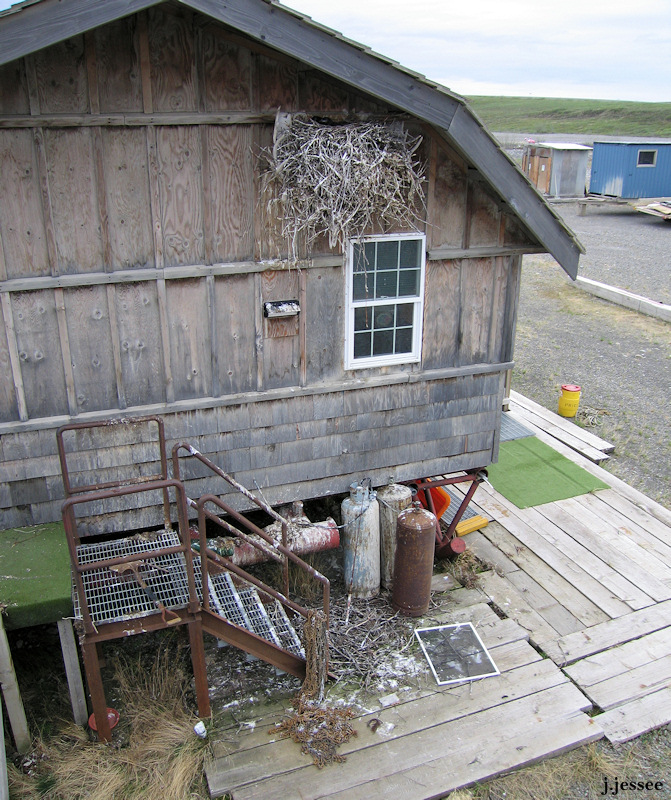
This raven nest, with 2 babies in it, is built in a set of moose antlers on the side of a building!
You can see how much of a mess the raven family has made with guano all over the steps, propane tanks and the side of the building.
 What a work of art!
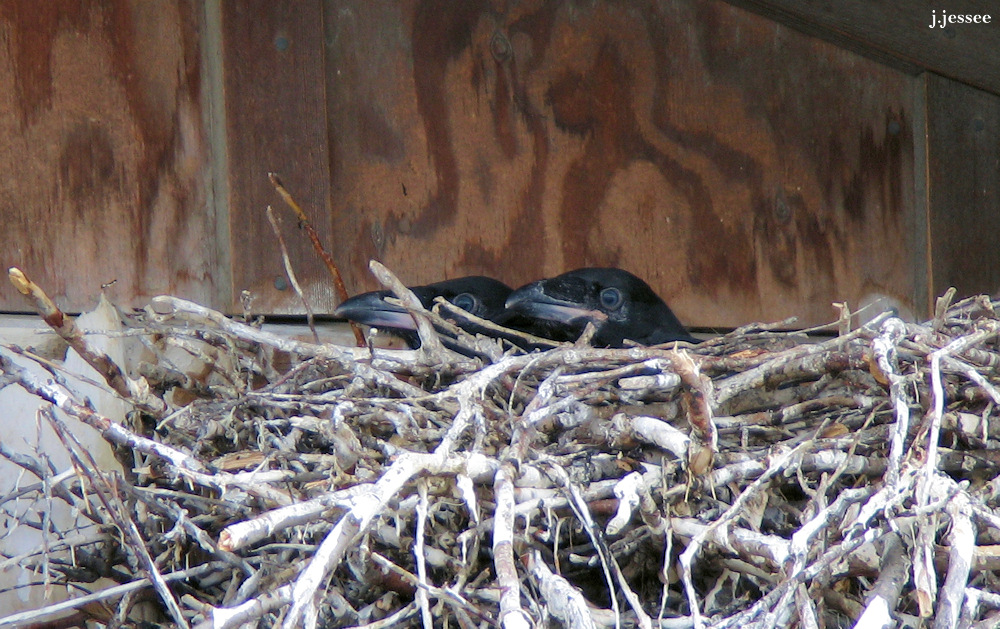
The “babies” were absolutely quiet and watchful while I snapped photos and even climbed up on a nearby truck to get on the same level as them. They did not seem traumatized. 🙂
Jack had a close encounter with a very friendly raven a few years ago too.
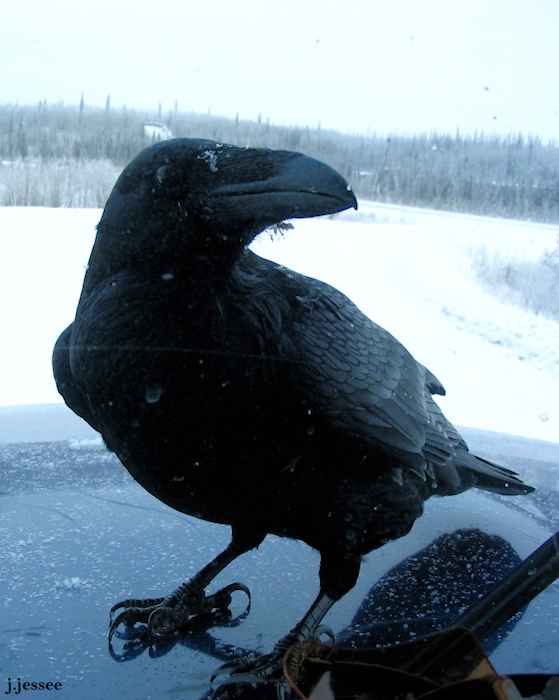
Raven sitting on Jack’s truck hood and peering inside the cab.


Don’t worry, I discussed with Jack how it’s not appropriate to feed wild animals and that it might even be against the law! 🙂
They are amazing creatures. So smart!
Another truck goes off the road! This one is about 20 miles from Prudhoe.
Happy Sunday everyone! We’re having a beautiful sunny day after some snow and a wind storm that cut out our electricity for a couple of hours last night.
Here’s a short video Jack took the other day at about mile 86 of the Dalton. The truck got too close to the edge when it met another truck and went off the side and rolled over. A tree trunk punctured the tanker and according to the Alaska Department of Environmental Conservation about 3,000 gallons of ultra low sulfur diesel spilled onto the ground. Here is a link to the local newspaper’s article about it.
Jack carries approximately 9,200 gallons in the tanker he uses. Other tankers are larger or smaller. All or most tankers have different compartments though so when one has a spill most likely it’s only that compartment that empties. Having different compartments enables truckers to carry different types of liquids and/or put weight at different places in the load.
(YouTube has a bad habit of giving you the lowest resolution so if you want to see more detail try clicking one of the HD choices under settings in the lower right hand corner of the video screen.)
It’s quite common for a really heavy load to have one or more push trucks behind it to push when going up inclines. Push trucks are commonly used on the Dalton Highway as well as the Parks and Richardson when the loads are outrageously heavy, otherwise it would take a very long time and so much fuel for the truck with the load to get up a mountain, and it would also impede traffic for long periods of time. The push trucks just follow the load when not going up hills.
Taken 11 years ago, these photos really show how close Jack’s push truck gets to the load he’s pushing (a crane). You can see the pad that the push bar pushes against, how the trucks make contact.


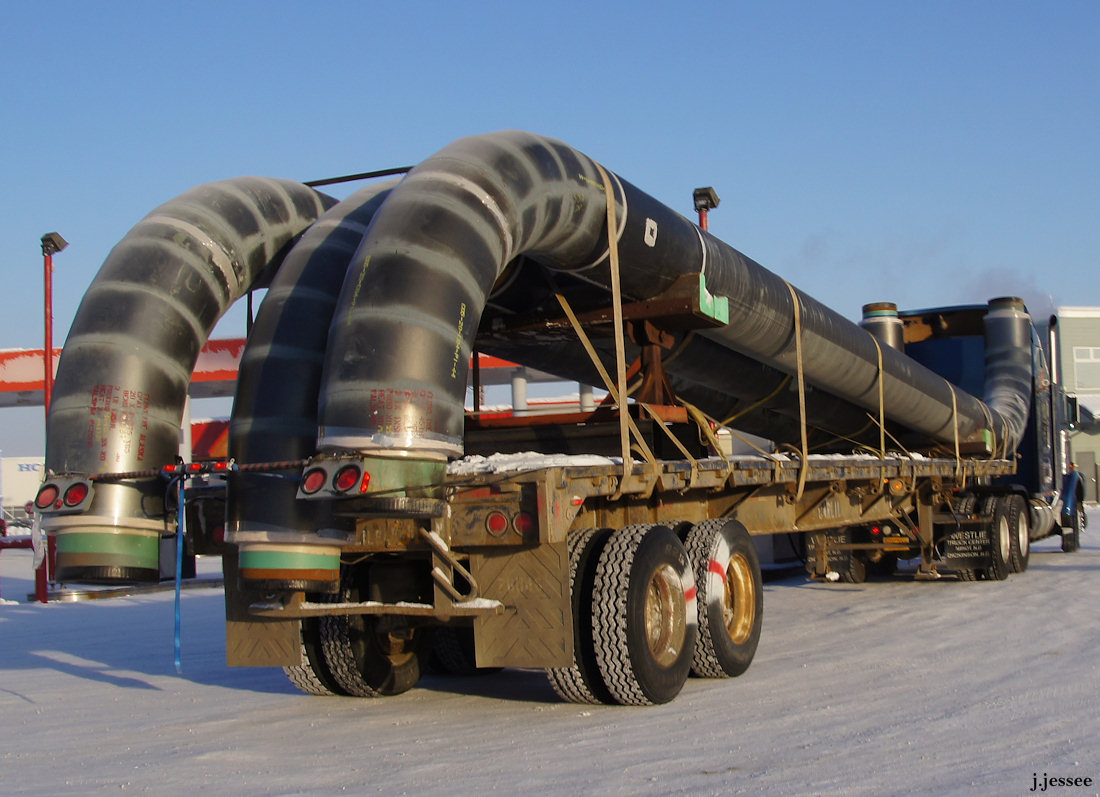 I snapped these on Friday when this truck was fueling up to head north.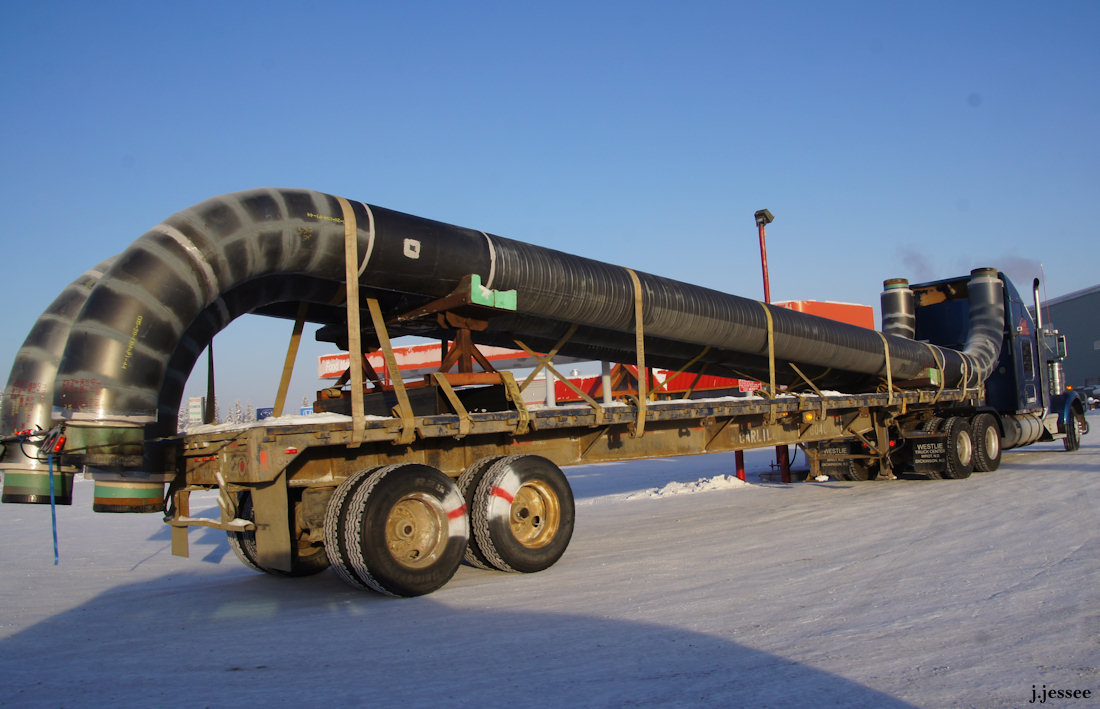
Jack says they are used for crude oil and that they lay on their sides, not upright like on the truck. You can see the actual metal portion of the pipe that is colored green with anti-corrosion paint. The black is thinner metal and in between the two is foam insulation.
This load is obviously going to Deadhorse or Prudhoe Bay. (FYI: Deadhorse refers to the “town” where companies have their operations, and Prudhoe Bay refers to the actual oil fields and is a much larger area.)
Click on the photos for larger images.
More snow in the engine, but this time it’s from someone going in the ditch! It seems to happen to everyone eventually and it’s better to land in the cushy snow instead of just about anywhere else. After it got pulled out they cleaned the snow off and drove it away!


(Identifying marks have been removed for privacy.)
Jack snapped these shots after going through numerous snow drifts before he got into Prudhoe Bay. The engine is operating fine and he didn’t need to do anything, but it’s interesting to see how the snow gets into all the available spaces. The keypad looking thing is actually the air intake for the cab and the vent above it is the intake for the motor. Even though the engine is 200 degrees plus it’s still not enough to melt the snow at these temperatures, about 20 or 30 below.


Jack took these photos a couple of days ago. The clouds have a really weird consistency to them, like there are air pockets underneath that are pushing them up in patches.


 The Jack Jessee Blog