Huge mod is pushed up “Koyukuk”

The hill that drivers call “Koyukuk” is right next to the Koyukuk River and it’s one of the steepest on the Dalton.  It’s about 30 miles south of Coldfoot.  The video was taken last winter.

Jack happened to be there to document this huge mod being pushed up the hill by push trucks and also being steered from the back because it’s so long.  If you look close you can see someone standing outside on the load as it goes up the hill – he’s steering the rear end as it goes around the curves.  The guy doing the steering is one of the former owners of Carlile and he comes up the Dalton for these types of loads that need some special care.  (Carlile was sold to Saltchuk Corporation a while ago.)

In case you are wondering, the truck is going pretty slow, about 5 miles an hour in 3rd gear.  The last thing you ever want to do, Jack says, is change gears when you’re going that slow with that much weight since you’ll stop before you get it into a different gear.  If you stop it’ll take a while to get going again and without the momentum you’re putting a lot of strain on the truck and there’s too much potential for breaking something.  The years Jack spent in heavy haul were great years he says, but he doesn’t miss it.


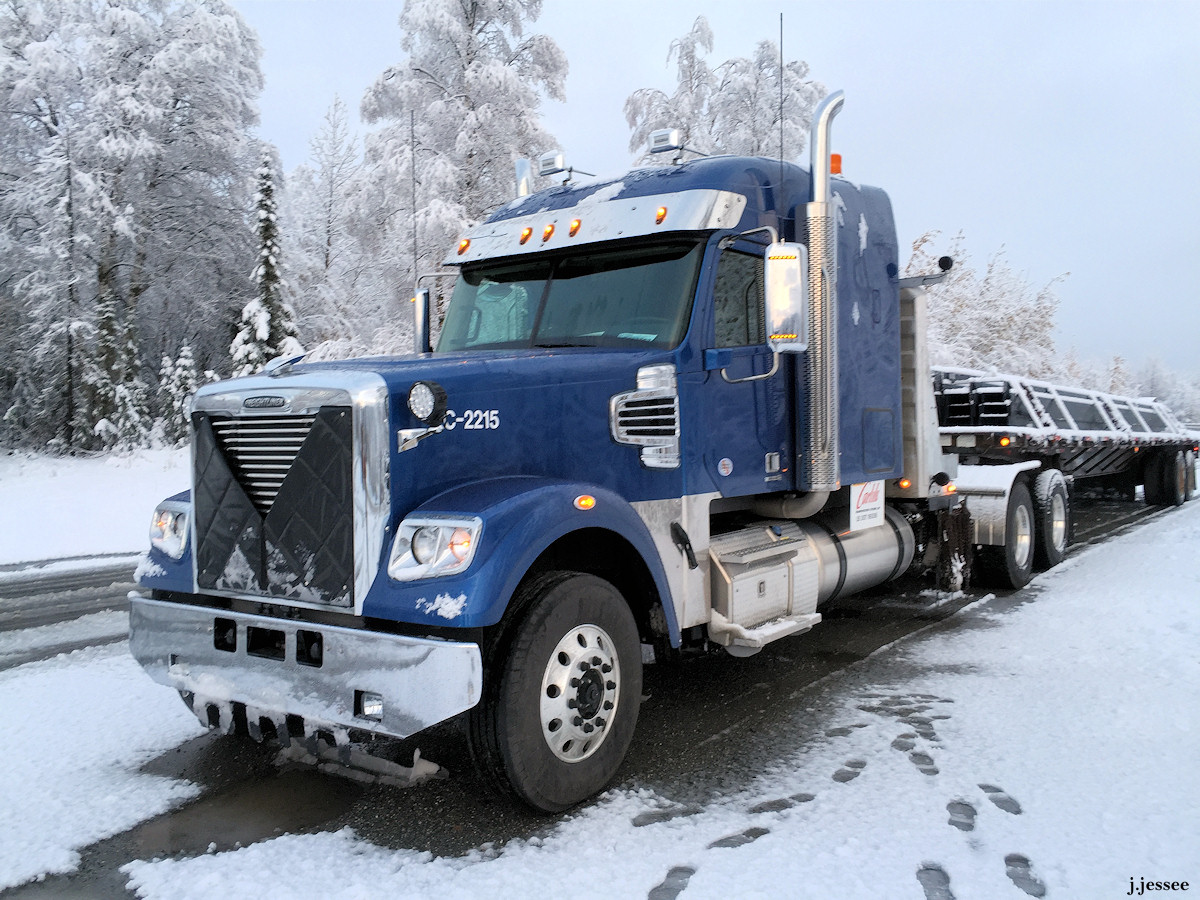
Jack’s Freightliner

Jack is driving a new truck, a Freightliner.  He’s discussed this a little in the comments section of the About page.  Jesse Aird asked:  “Why the Freightliner? Hard to beat a W9.”  Jack answered:

“Well, my bosses asked me if I wanted to try it out and I know a lot of owner operators have them up here and like them, so I did. Turns out the engine is great (DD16), there’s lots of room in the cab, and I don’t feel exhausted at the end of several trips in a row, maybe because of the comfortable seat. The truck rides better. I don’t care what brand it is as long as it’s comfortable and reliable.”

He added to Pete Wylie aka Straight Arrow:  “There is something about the Freightliner that makes a better ride. It takes bumps better.”

So there you have it, why Jack is driving a Freightliner.

Happy New Year!

Pushing a crane

It’s quite common for a really heavy load to have one or more push trucks behind it to push when going up inclines.  Push trucks are commonly used on the Dalton Highway as well as the Parks and Richardson when the loads are outrageously heavy, otherwise it would take a very long time and so much fuel for the truck with the load to get up a mountain, and it would also impede traffic for long periods of time.  The push trucks just follow the load when not going up hills.

Taken 11 years ago, these photos really show how close Jack’s push truck gets to the load he’s pushing (a crane).  You can see the pad that the push bar pushes against, how the trucks make contact.

A raven’s eye tour of Fairbanks

Flying into Fairbanks one day in 2008 the airplane took an unusual route.  Instead of coming in from the southwest it came in from the southeast, flying over Harding Lake and Salcha and circling over Farmers Loop across north of town into the airport.  Maybe this direction of landing is normal, I don’t know, I have never experienced it before, but this day happened to be beautifully clear and I captured some great photos of the Tanana River and various Fairbanks landmarks.

Click on the first one and then scroll to the right for an overhead, raven’s eye, tour of Fairbanks.

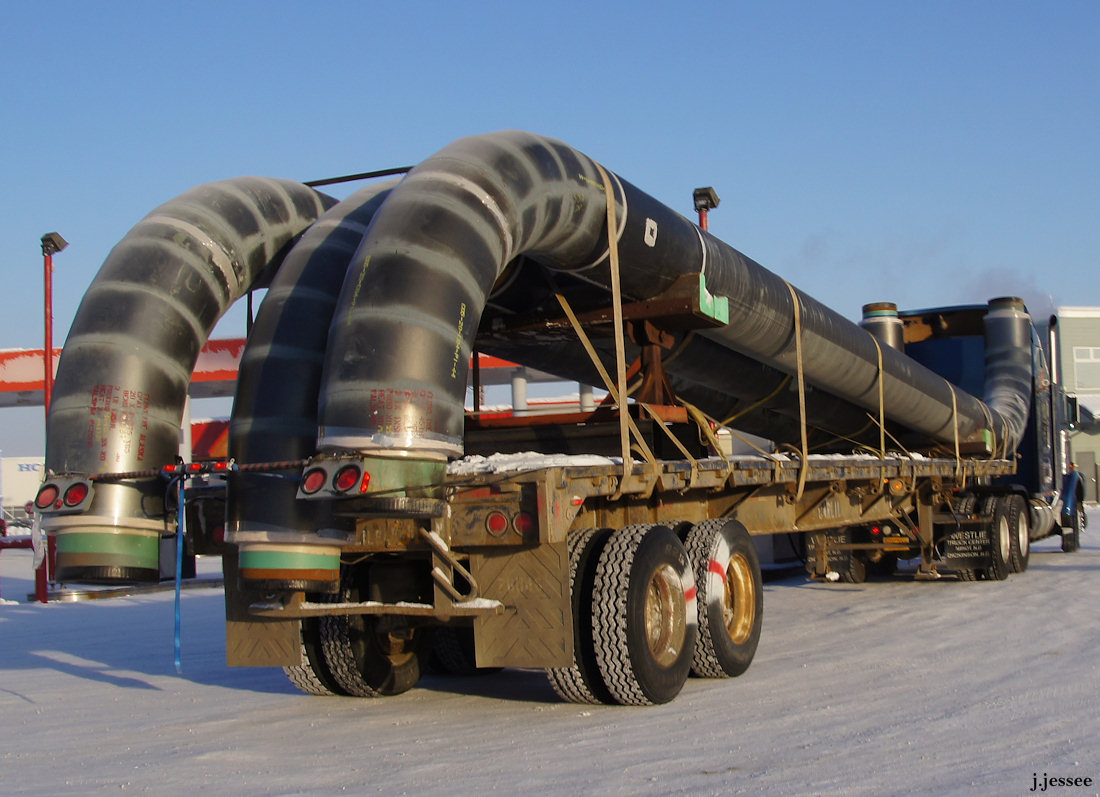
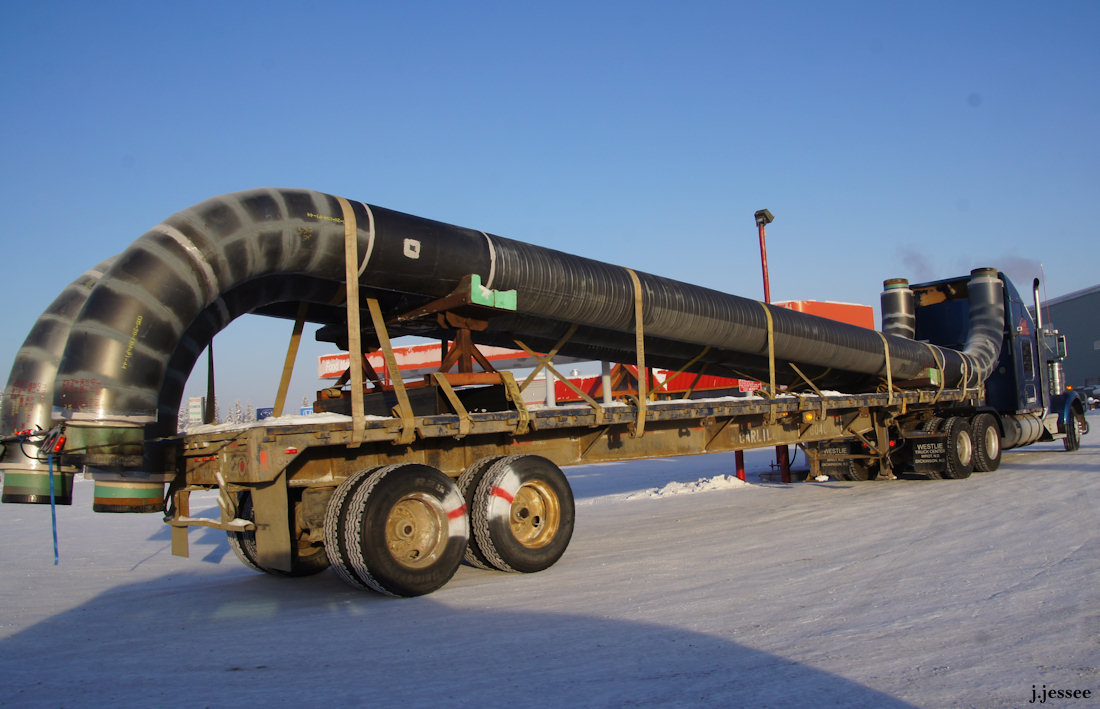
Curved directional pipe for crude oil

Crude oil pipe on truckI snapped these on Friday when this truck was fueling up to head north.Crude oil pipe on truck

Jack says they are used for crude oil and that they lay on their sides, not upright like on the truck. You can see the actual metal portion of the pipe that is colored green with anti-corrosion paint.  The black is thinner metal and in between the two is foam insulation.

This load is obviously going to Deadhorse or Prudhoe Bay.  (FYI:  Deadhorse refers to the “town” where companies have their operations, and Prudhoe Bay refers to the actual oil fields and is a much larger area.)

Click on the photos for larger images.


Snow-filled engine compartment

Jack snapped these shots after going through numerous snow drifts before he got into Prudhoe Bay.  The engine is operating fine and he didn’t need to do anything, but it’s interesting to see how the snow gets into all the available spaces.  The keypad looking thing is actually the air intake for the cab and the vent above it is the intake for the motor.  Even though the engine is 200 degrees plus it’s still not enough to melt the snow at these temperatures, about 20 or 30 below.

The engine after going through snow drifts

Snow filled engine

Mod Lift at Alpine

Hard to believe this was 10 years ago, Jack says.  This is a mod lift at the Alpine oil fields (mod is short for modular), back when he was doing heavy haul.  Since it’s been so many years all he had to say about it was that he hauled this prefabricated unit to Alpine from Valdez and the workers there got busy lifting it off his truck.  It took all day actually.  That was one part of heavy haul he doesn’t miss.


Donjek River Bridge, follow up

A few months after Jack helped haul bridge beams to the Donjek River Bridge in Canada, he went back to haul the beams from the staging area off the road onto the ice where they were constructing the bridge. (Best viewed if you click on the first one and scroll to the right.)  See captions for more info.

Hauling Pipe Rack Units to Prudhoe

A few years ago Jack and some other truckers took these pipe rack units from Fairbanks to Alpine, an area of Prudhoe Bay owned by Conoco-Phillips.  You’ll see the units being loaded, then Jack driving behind other units. You can see the pipes in the middle of the structure as well as the valve controls on the top.  These units are lined up next to each other and connected as part of the process of extracting oil and getting it into the pipeline to go south.  In one of the ice road photos you can see a pipeline on the right.

They drive through tundra, over mountains, and finally on the ice roads of Prudhoe Bay.  The last couple of photos, the ones where the road doesn’t look particularly icy, they are passing over a river.  If you are also rather astute (and here I am giving you a clue) you can also see Jack’s reflection in the mirror, as well as a reflection of the small fan that he had mounted on the dash that could turn toward the windshield to defrost it or toward him on hot days.

(The best way to view the photos is to click on the first one and then click on the right arrow.)